Problem framing, strategic thinking, and positioning.
25 pages
"The essence of strategy is
choosing what not to do.”
Michael PorterDon’t just accept
the assignment
It’s rare a brief or other
assignment doesn’t need to be
reframed or explored in a fresh
way to yield the best solution
possible.The art of framing your problem
Start with the business issue and then explain why it’s happening
We’ve lost 10% chewing gum
purchase at the till BECAUSE
people now queue looking at
their phones rather than looking
at the marketing displays.
Despite having great brand love
and great taste metrics, people
still don’t consume us at lunch
time BECAUSE Lipton is perceived
as a refreshing drink that is
associated with thirst not food.
There are 4 types of problem:
Category
Product
Brand
Culture
Quorn’s (meat substitute)
s a l e s a r e p l a t e a u i n g
BECAUSE we’re reaching a
saturation point with the
vegetarian market in the
UK.
People don’t buy Skoda
BECAUSE its synonymous
with losers due to the
poor performance of its
cars.
Despite product love,
Southern comfort fails to
convert at POS BECAUSE
there are social pressures
when ordering at the pub
due to whiskey status.
Weight watchers is losing
m a r k e t s h a r e t o n e w
entrants BECAUSE there is
a shift from being skinny
to being healthy and
strong.
Explain why it’s happening
Business Problem
@groupthinkSeven Rules for Brand Growth
After several bruising rounds of marketing
myth-busting, HBG outlines 7 scientifically
derived rules for brand growth:
1. Continuously reach all buyers of the
category (communication and distribution) –
avoid being silent [the job of media plan]
2. Ensure the brand is easy to buy (mental and
physical availability) [the job of
distribution and e-comm]
3. Get noticed (grab attention and focus on brand
salience to prime the users mind) [The job of
advertising]
4. Refresh and build memory structures (respect
existing associations that make the brand easy
to notice and easy to buy) [The job of
advertising]
5. Create and use distinctive brand assets (use
sensory cues to get noticed and stay top of
mind) [The job of advertising]
6. Be consistent (avoid unnecessary changes,
whilst keeping the brands fresh and
interesting) [The job of advertising, media]
7. Stay competitive (keep the brand easy to buy
and avoid giving excuses not to buy (i.e. by
targeting a particular group) [Everyone’s job]
SOURCE: Byron Sharp, “How Brands Grow”Comms
Marketing
Business
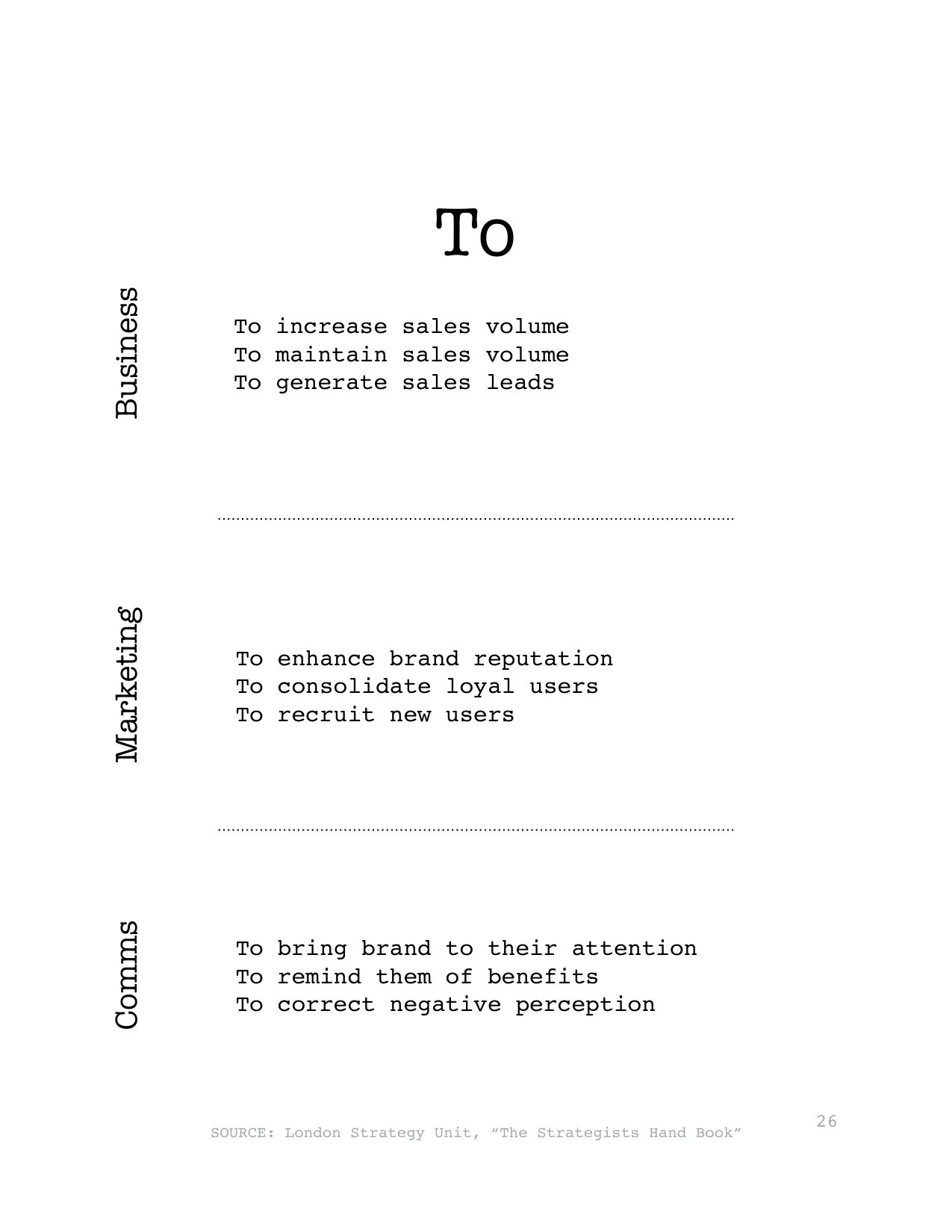
To bring brand to their attention
To remind them of benefits
To correct negative perception
To enhance brand reputation
To consolidate loyal users
To recruit new users
To increase sales volume
To maintain sales volume
To generate sales leads
To
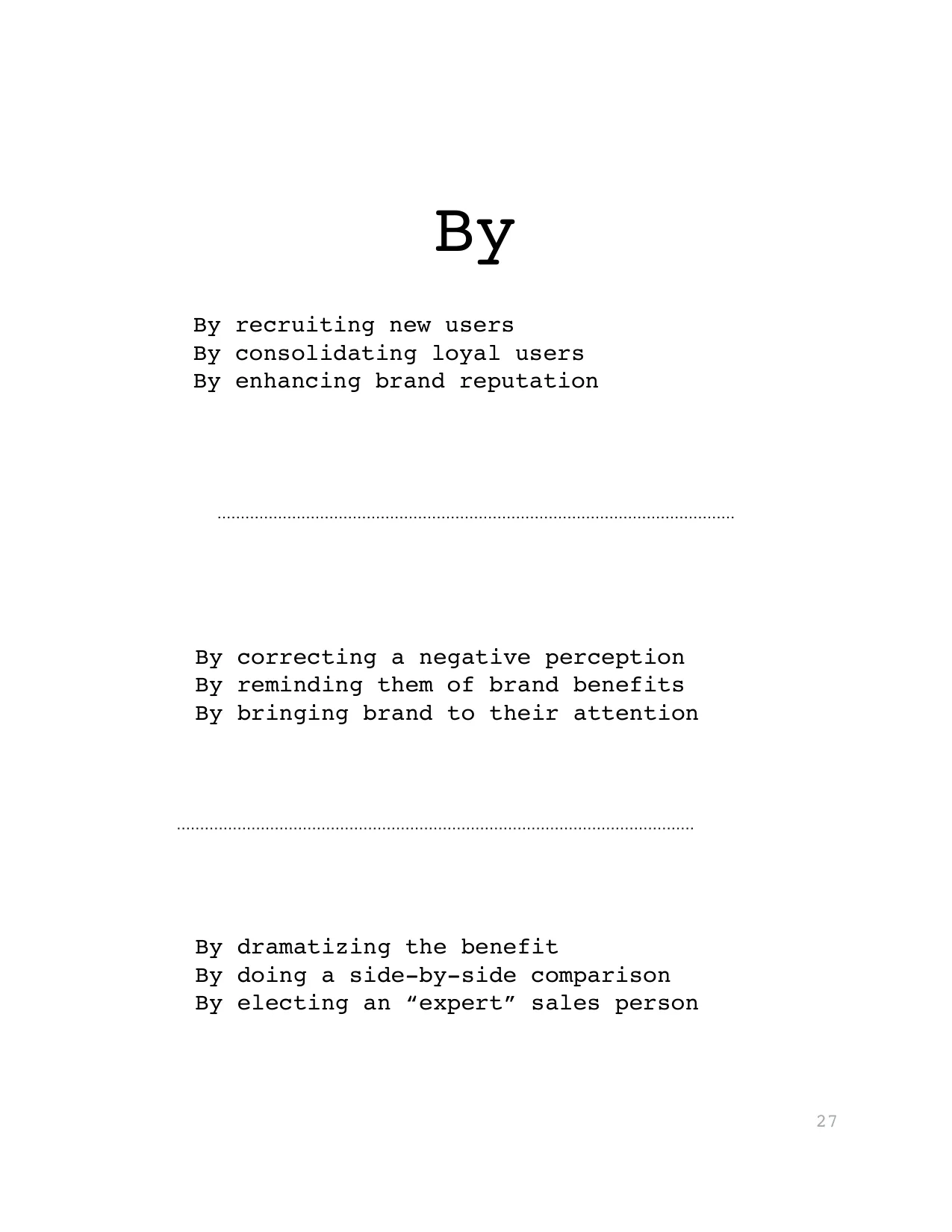
SOURCE: London Strategy Unit, “The Strategists Hand Book”By dramatizing the benefit
By doing a side-by-side comparison
By electing an “expert” sales person
By correcting a negative perception
By reminding them of brand benefits
By bringing brand to their attention
By recruiting new users
By consolidating loyal users
By enhancing brand reputation
ByWhy?
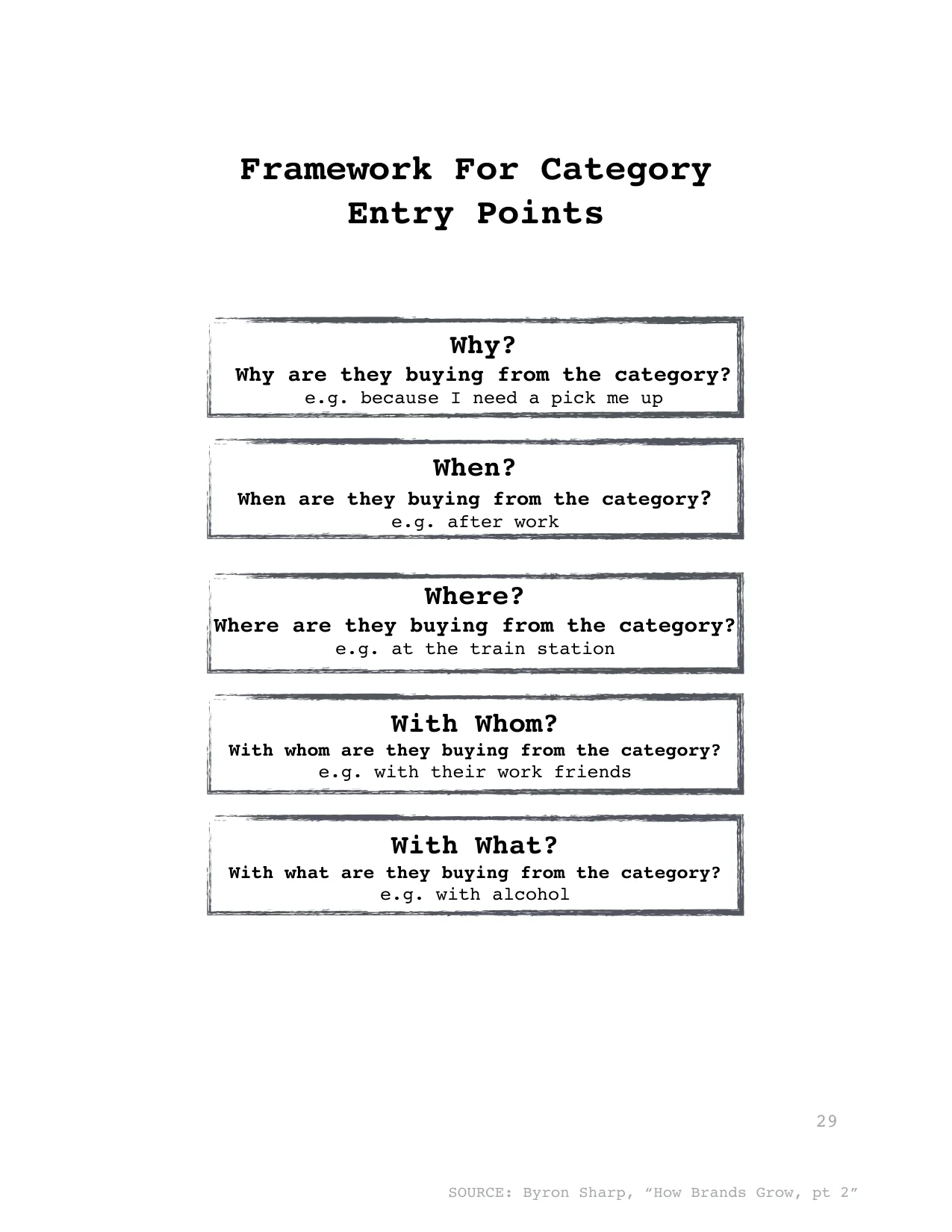
Why are they buying from the category?
e.g. because I need a pick me up
When?
When are they buying from the category?
e.g. after work
Where?
Where are they buying from the category?
e.g. at the train station
With Whom?
With whom are they buying from the category?
e.g. with their work friends
With What?
With what are they buying from the category?
e.g. with alcohol
SOURCE: Byron Sharp, “How Brands Grow, pt 2”
Framework For Category
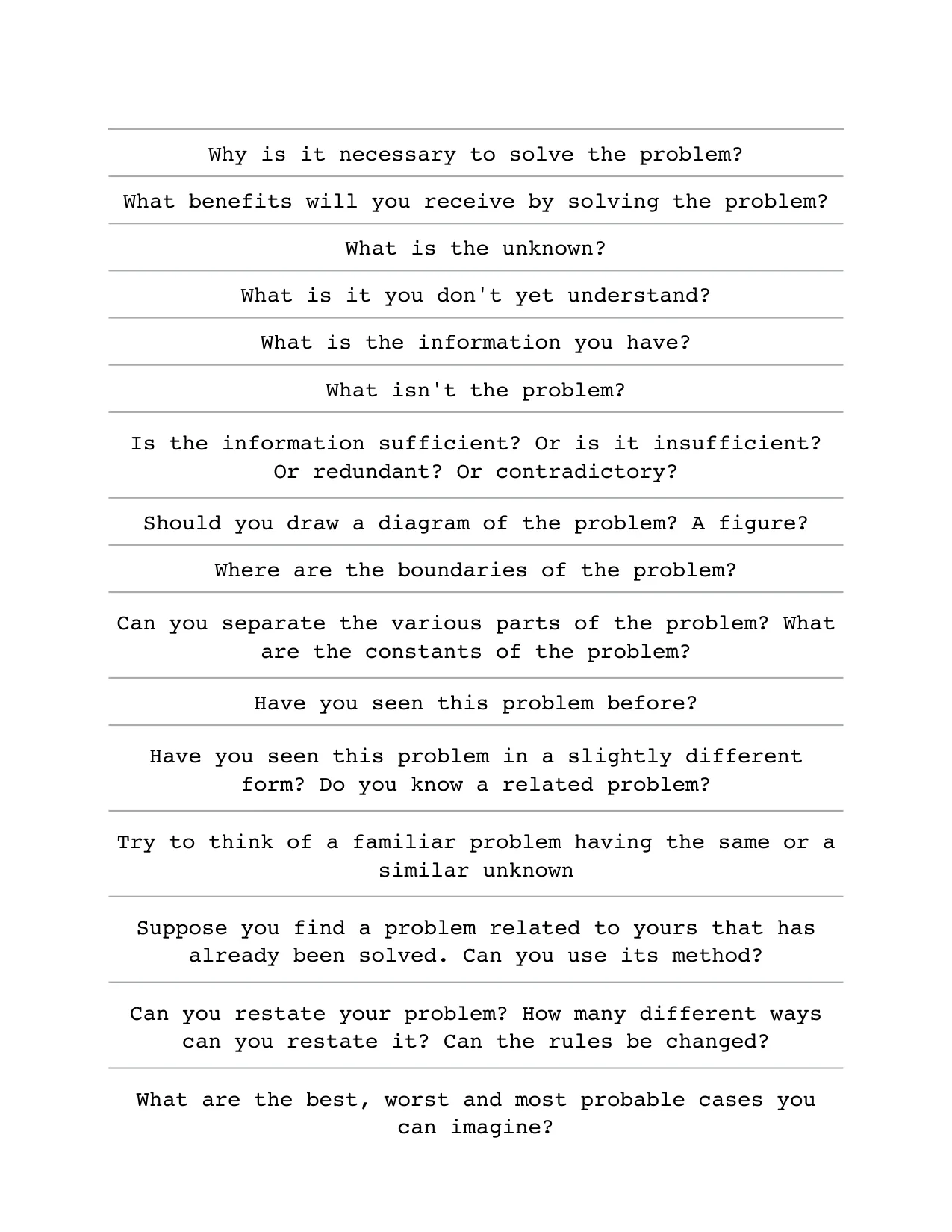
Entry PointsWhy is it necessary to solve the problem?
What benefits will you receive by solving the problem?
What is the unknown?
What is it you don't yet understand?
What is the information you have?
What isn't the problem?
Is the information sufficient? Or is it insufficient?
Or redundant? Or contradictory?
Should you draw a diagram of the problem? A figure?
Where are the boundaries of the problem?
Can you separate the various parts of the problem? What
are the constants of the problem?
Have you seen this problem before?
Have you seen this problem in a slightly different
form? Do you know a related problem?
Try to think of a familiar problem having the same or a
similar unknown
Suppose you find a problem related to yours that has
already been solved. Can you use its method?
Can you restate your problem? How many different ways
can you restate it? Can the rules be changed?
What are the best, worst and most probable cases you
can imagine?