Finding insights, research methods, and consumer behavior.
30 pages
Start Doing Research Differently
1. Don’t only talk to the consumer. Talk to
someone who spends their life
understanding the target. Wife, kids,
boss, subordinate, neighbor, garbage man,
probation officer
2. Send them a disposable camera and a one-
time brief
3. Get them to write something and word
cloud it
4. Set up a video confessional booth
5. People love playing marketer. Give them
your job
6. Think of the rote thing to do. Do the
opposite
7. Get 10 smart people to write 10 Onion
headlines for your brand or category
8. Go to their house as a forensic
criminologist
9. Pitch ideas like this at your account
people until you give them one that makes
them think you’re insane. Then do that
one
SOURCE: FCB, “Getting to what Matters”• has nothing to do with what you’re working on,
but is interesting
• is in a very different discipline or medium, but
has a similar idea to what you’re interested in
• is from a different perspective experiencing your
work (a viewer, etc)
• is deep within academic research understanding of
your topic
• is on twitter or instagram or other social media,
writing about what you’re interested in
• is self-published, a zine, word on the street
• Is on wikipedia, related to your topic
• is historical work, written at least 10, 20, or
40 years ago about your topic
• Written by someone least connected to the topic
• written by someone most connected to your topic
• written by someone who isn’t white
• written by someone who isn’t a man
• written from an adjacent industry
• written by someone much older than you are
• written by someone much younger than you are
We will pursue
research that…Write a Discovery Brief.
Create a list of questions you need to answer via
research in order to write an informed,
substantiated brief. Questions will likely
investigate topics such as:
1.
What has worked / not worked for the category in
the past?
2.
What have/are competitors done/doing?
3.
Who are the current buyers? / Who are the current
non-buyers?
4.
Why aren’t people buying it?
5.
What motivates purchase (or hesitation) in the
category?
6.
What cultural conversations are related to the
product, category, or brand?
7.
What occasions is the product used in?
8.
What are the conventions for advertising in this
category (maybe to follow them, maybe to break
them)?
9.
What animates consumers about the product,
category, or brand on social media?
10. What tension/controversy/fears exist in the
category?
11. What does this product say about the buyer?
SOURCE: FCB, “Getting to what Matters”What have
been your
top sources
of insight
for your
strategy
work?[advertising] is always about the
future buyer. It offers him an image
of himself made glamorous by the
product or opportunity it is trying
to sell.
The image then makes him envious of
himself as he might be.
Yet what makes this self-which-he-
might-be enviable?
The envy of others.
[advertising] is about social
relations, not objects, its promise
is not of pleasure, but of happiness
“
”7 ways to get numbers that matter
1. Be vigilant. Looking every day for something
that could make matters easier
2. Search outside the usual sources
3. Get more minds on it
4. Juxtapose. Put related numbers together to
create new information
5. Try different contexts. What’s the social
angle? The emotional angle? Put it in terms
of time or length or volume
6. Turn them over. 2% one way might not be as
interesting as 98% the other way
7. Field questions nobody’s asking
8. Compare it to something unrelated and absurd
e.g. Amount of people killed by cattle every
year // number of films Nicholas Cage has
appeared in // odds of winning on a $20
scratch ticket // total number of space
launches this year // total panels drawn by
Bill Waterson // Acres of pear trees in the
U.S. //… Just make it drive home your point.
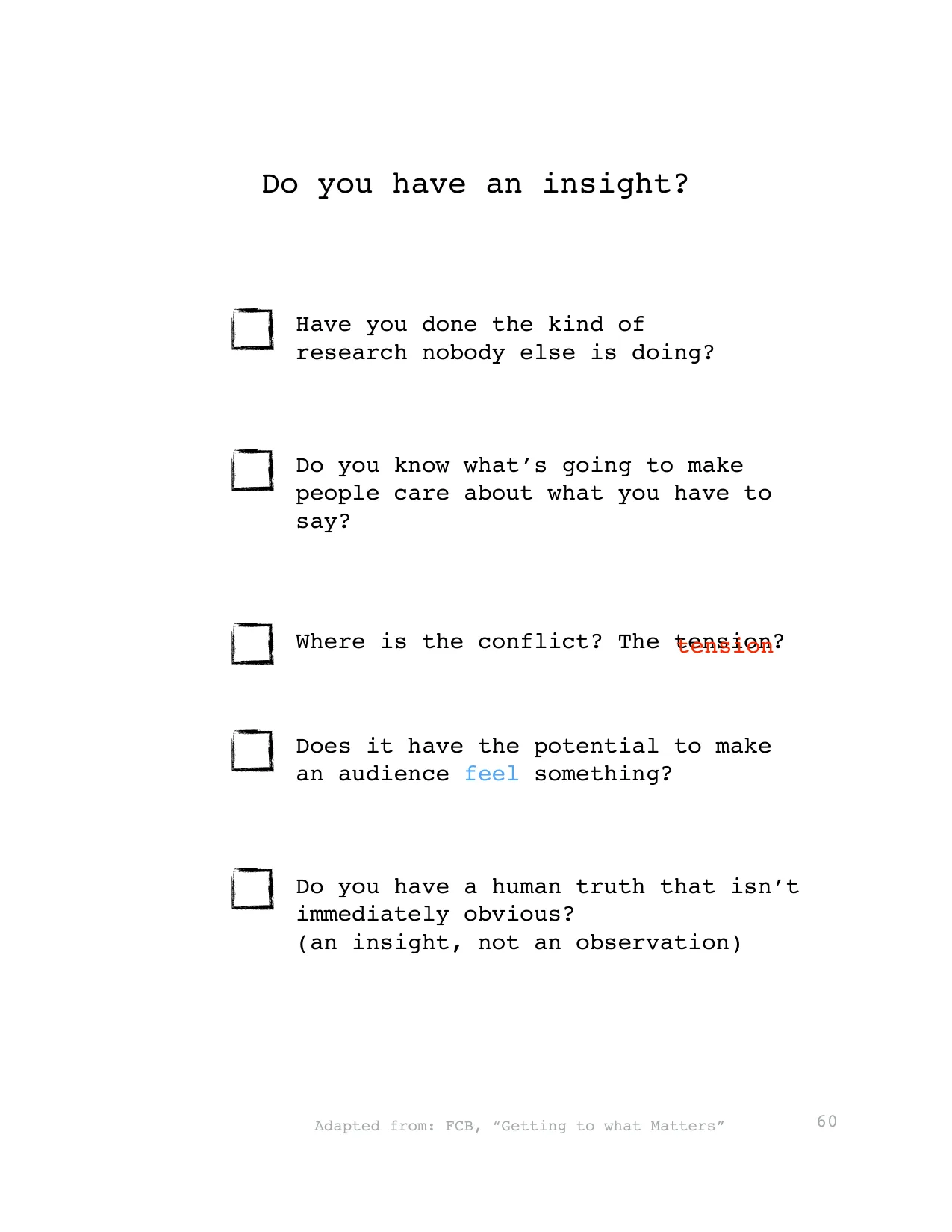
SOURCE: FCB, “Getting to what Matters”Do you have an insight?
Have you done the kind of
research nobody else is doing?
Do you know what’s going to make
people care about what you have to
say?
Where is the conflict? The tension?
tension
Does it have the potential to make
an audience feel something?
Do you have a human truth that isn’t
immediately obvious?
(an insight, not an observation)
Adapted from: FCB, “Getting to what Matters”

![[advertising] is always about the
future buyer. It offers him an image
of himself made glamorous by the
product or opportunity it is trying
to sell.
The image then makes him envious of
himself a](/pages/page-048.webp)